Pull up any portal page for Warson Woods and you will get a confident number. Pull up a second portal and you will get a different confident number. Pull up a third and the gap between them is wider than the down payment on a starter home. The number is not lying. It is just describing a market that is too small to have a stable middle.
That is the thesis of this post. In a half-square-mile city with roughly 800 homes and about ten recorded sales a year, the "median price" is closer to weather than to gravity. What sets a Warson Woods price is block, vintage, and lot, and the only way to read the market is to stop asking what a home costs on average and start asking what a home like this one has traded for recently.
The median problem, in one table
Here is the same city, in the same window of recent history, described by four different sources.
| Source | Reporting period | Reported figure |
|---|---|---|
| Movoto | February 2026 | ~$545K median list price |
| Redfin | June 2026 snapshot | $485K median sale, 5 days on market, 102.7% sale-to-list |
| Homes.com | Trailing 12 months (as of mid-2026) | $639,200 average sale price |
| Rocket Homes | December 2024 | $860,000 median sold price |
None of those sources is wrong. They are describing a city where the sample is small enough that a single unusual sale moves the reported "middle" by six figures. Homes.com's own count for the trailing twelve months was ten sales. Ten. That is not a market you can average. That is a list you can read.
Why the sample stays small
Warson Woods covers 0.58 square miles and had a 2020 census population of 2,018, with 791 housing units recorded in the 2010 count. The city has held that footprint since the mid-twentieth century, and the housing stock reflects the postwar building push that peaked between 1940 and 1960. Turnover is low because owners tend to stay. That is a structural fact, not a marketing line, and it is why any month can produce two sales, or five, or one.
Small sample also means seasonality distorts the reported median more than it would elsewhere. A single mid-century ranch trading in a slow month can drag the number down. One new-construction closing on Simmons Avenue can drag it up past a million dollars, because that is what current infill product like the Genesis Development listing near $1.15M actually prices at.
What the money actually buys
If you sort the current and recent inventory by price band instead of averaging it, the ranges tell a clearer story than any median.
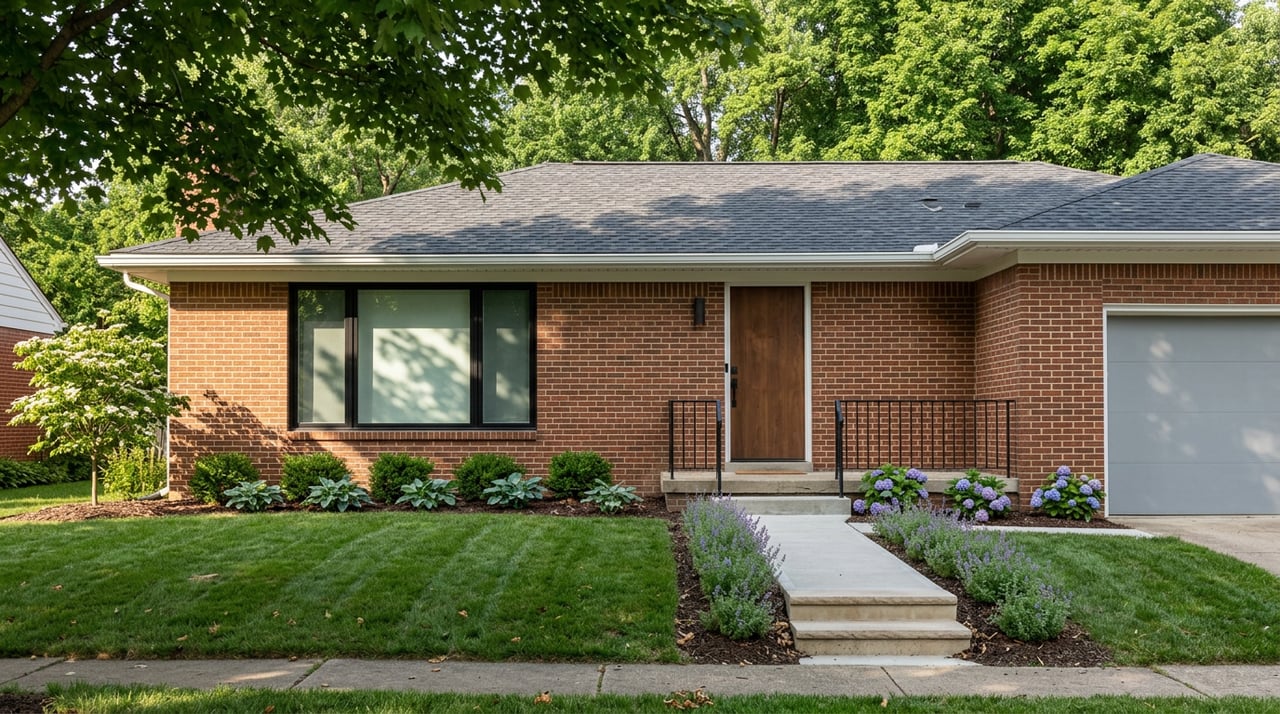
The $395K to $525K band. This is where the original Warson Woods housing stock lives. Three-bedroom, two-bath brick ranches from the 1950s on small lots, often updated but not fully renovated. Recent examples from public MLS activity include pending listings at $395,000 (2 beds, 2 baths, 2,145 sq ft), $499,900 (3 beds, 2 baths, 3,054 sq ft with lower-level finish), $510,000, and $515,000. Days on market for this band have been sitting near single digits when the home shows well.
The $545K to $600K band. Updated ranches and story-and-a-halfs, often with a modernized kitchen and a finished lower level. A representative active listing sits at 1400 Norman Place, a 3-bed, 3-bath, 1,882-square-foot home at $545,000 with 26 days on market as of the most recent snapshot. Homes at $579,000 and $585,000 on Norman-adjacent streets have moved through in the same window.
The $700K to $900K+ band. Larger renovations, professionally redesigned interiors, or the occasional architecturally significant home. Redfin's listing history includes a fully remodeled ranch marketed as a "luxury" example of the type, with custom cabinetry, a chef's kitchen island, and a finished basement. This is also where you find the mid-century modern outliers, including the 1956 home originally designed by the then-Dean of the Washington University School of Architecture and later renovated by architect Phil Durham.
The $1M+ band. Almost entirely new-construction infill. Genesis Development's 3,144-square-foot new build on Simmons Avenue at $1,149,900 is the current benchmark. These are teardown-and-rebuild economics, and the pricing reflects land value plus new-build cost, not comps against the existing stock.
Read across the bands and the point becomes obvious. A citywide median has to pick one of these four stories to tell, and by picking one it hides the other three.
The Manchester Road edge does the amenity work
One reason Warson Woods holds price so tightly is that the interior is almost purely residential while Manchester Road on the southern border carries the commercial load. That structure is unusually clean for a city this size, and it is deliberate. Commercial development effectively paused from 1957 until 1994, when the city reaffirmed its residential focus, according to the Janet McAfee community history.
The current Manchester frontage reads like a walkable errand list rather than a strip. Vangel's Restaurant and Bar at 10017 Manchester Road, opened by Louie Vangel of the Charlie Gitto's family in the space formerly occupied by J Greene's Irish Pub, gave the corridor a serious dinner anchor. Dierbergs Markets at 9901 Manchester covers the grocery run. A new 7 Brew Coffee opened at 10001 Manchester Road, and the city's board of aldermen approved a preliminary development plan for a Caribou Coffee location on the corridor in July 2024. Nourish by Hollyberry at 10037 Manchester still handles the prepared-meal niche. The Warson Village Shopping Center, built in 1948, was the first strip shopping center in St. Louis County, and the corridor has been iterating on that original template ever since.
For a buyer, this matters because the amenity value is essentially external to the housing stock. You are not paying for a mixed-use village fabric inside the city. You are paying for proximity to a corridor that supplies it.
Reading a Warson Woods comp like an insider
If you are shopping this market, the median is not the number to anchor on. The block is. Here is what to ask an agent to pull instead.
- Sales on the specific street or the two nearest parallel streets within the last twelve months. Warson Woods streets differ in lot depth and tree canopy in ways the city average cannot see.
- Vintage and footprint of the subject compared to those comps. A 1955 ranch at 1,600 square feet and a 1958 story-and-a-half at 2,400 square feet are two different products even at the same address range.
- Whether the comp was a renovation flip, an owner update, or a teardown-rebuild. Renovation flips price at a premium to owner-updated homes of the same size, and teardown-rebuilds set land value, not house value.
- School district assignment for the specific address. Warson Woods is served by both the Kirkwood and Webster Groves districts, and the boundary runs through the city. This affects the comp set more than most buyers expect.
- Sale-to-list ratio on that street. Redfin's June 2026 snapshot for the city as a whole showed 102.7% sale-to-list at 5 days on market. Individual streets can run above or below that.
A good listing agent should be able to answer all five in one conversation. If the answer starts with a citywide average, you are getting a portal reading rather than a market reading.
FAQ
Is Warson Woods a seller's market right now? By the two indicators that matter most in a low-inventory city, yes. Recent snapshots have shown median days on market in the single digits and sale-to-list ratios above 100%, meaning well-prepared homes are trading at or above ask. That said, the small sample can flip a monthly reading, so the trend matters more than any single month.
Why do the online medians disagree so much? Different portals use different windows, different definitions (list price versus sold price versus average versus median), and different data feeds. Layered on top of a city that produces roughly ten to thirty recorded transactions a year, those methodology differences produce very different numbers from the same underlying market.
Are new-construction prices "real" comps for older homes? Not directly. New-construction infill in Warson Woods reflects the cost of land plus new-build construction and finishes. It sets a ceiling that pulls up land value across the city over time, but it should not be used as a comp for a 1950s ranch that is not a teardown candidate.
How should a downsizer or estate seller think about pricing here? Start with the block-level comp set and the specific vintage of the home, then decide how much prep and staging investment makes sense before listing. In a market with this much sale-to-list strength on well-prepared homes, the difference between a lightly presented listing and a fully prepared one often shows up in the final price rather than in time on market.
If you are weighing a move into or out of Warson Woods and you want the block-level read rather than the citywide average, the team at Finest Homes Network can pull the specific comps for your street, walk through what your home would list for today, and lay out a prep-and-pricing plan built for a market this small. Schedule a consultation when you are ready.